Vaud has a lot to offer the wine-loving history buff with dozens of castles and miles of terraced vineyards to choose from. There are grand chateaux in strategic positions along the lake, hillside palaces with views of the Alps and beyond, and humble estates barely worthy of the “chateau” moniker. But it’s not the size or relative importance that matters. It’s more about the sense of purpose and economic prosperity wine brought to every day life. Today, as a visitor, you might find a former dungeon is now a tasting room or a cavernous medieval dining hall a dance floor or a venue for weddings and private parties. In many, the history in each nook and cranny is palpable with portraits of owners past, various coats-of arms, and battered relics of war hanging from the walls. And where winemaking is a feature, the heavy scent of damp stone and decay is softened by the familiar odor of fermentation.
One of the best visits is to the Château de Glérolles, a pristine 14th century castle and vineyard overlooking Lake Geneva in the commune of St-Saphorin. The castle’s current site is as historic as it is dramatic. It stands precisely where the ill-fated hamlet of Glerula once stood, before it was washed away by a tsunami in the year 563—the Tauredunum event—which decimated lakeside populations all the way to Geneva.
The story of modern Glérolles begins in 1977 when Maurice Cossy, a local politician, purchased the entire property he shared with relatives. Even though Cossy was born into a well-to-do winemaking family and earned a degree in viticultural from the agricultural school at Marcelin, he was never a vigneron.
That’s not to say he wasn’t immersed in the business of wine. After earning his degree in 1938 he served as secretary of Vaud Wine Promotion and president of the Vaud Wine Fair. In 1950 he began his political career with an 18-year run as mayor of St-Saphorin, followed by an 8-year stint as a member of the National Council representing Vaud. During his public service he also found time to head up the vineyard commission. He was also co-founder of the Confrérie du Guillon and a board member of the Confrérie des Vignerons—organizers of the iconic Fête des Vignerons—until his death in 1999.
Not only was Cossy a busy man, it appears he did not suffer fools.
In 1979 he famously sued the very organizations he used to run when they demanded that unauthorized humagne rouge vines be removed from the property. He had surreptitiously planted them upon his takeover. Needless to say, given his standing in the community, his case prevailed. Today, thanks to Monsieur Cossy’s hutzpah, Glérolles is the only winery outside Valais to feature humagne rouge among its offerings.
These days, the Glérolles estate is owned by a partnership and managed by Les Frères Dubois, owners of the great Dézaley-Marsens brand, Vase Nº4, one of the three undisputed greats on the Mt. Rushmore of chasselas.
Like the Cossys, the Dubois family has deep roots in Vaud and are the perfect custodians for this historic vineyard and winery. On this trip I was lucky enough to meet with younger brother, Grégoire, who took the time to show me around this magnificent property.

The château looking east.
The Vineyards
The Glérolles estate is split into two parts, each more or less corresponding to the two brands they offer: Château de Glérolles and Planète. Both are located on terraced vineyards that sweep up from the lake adjacent to the railway line that serves a number of famous wine villages. For this article I will concentrate on the Glérolles wines.
The home vineyard, above the castle, is the source for their flagship chasselas cuvée, Réserve Blanche. A few hundred meters down the road, in the village of St-Saphorin, are a number of smaller parcels known collectively as Es Planètte. This is where most of the red grapes are planted, including the aforementioned humagne rouge. Other red grapes include cabernet franc, pinot noir, merlot, syrah, and diolinoir.

From an old painting in the castle showing the site where humagne rouge vines are planted today
The Glérolles wines are all Grand Cru, not by dint of terroir like Calamin or Dézaley, but because they conform to a cahier des charges spelled out in the canton’s wine laws. To be eligible for Grand Cru designation all grapes, red and white, must exceed by 5º oechsle the minimum sugar levels set by statute. For example, chasselas must reach 70º oechsle instead of the AOC minimum of 65º. Minimum oechsle levels for Calamin and Dézaley are set by the same statute at 71º for the whites and 85º for the reds.
Glérolles’ other cuvées include the Réserve Noire, made from a blend of the red grapes mentioned above, and a varietal humagne rouge. The term Réserve requires only that white wines be held back from commercial release for 12 months, or until October 1 of the year following harvest. For the red wines the holding period is 18 months.
That’s it. The trim Glérolles product line is all of three cuvées.
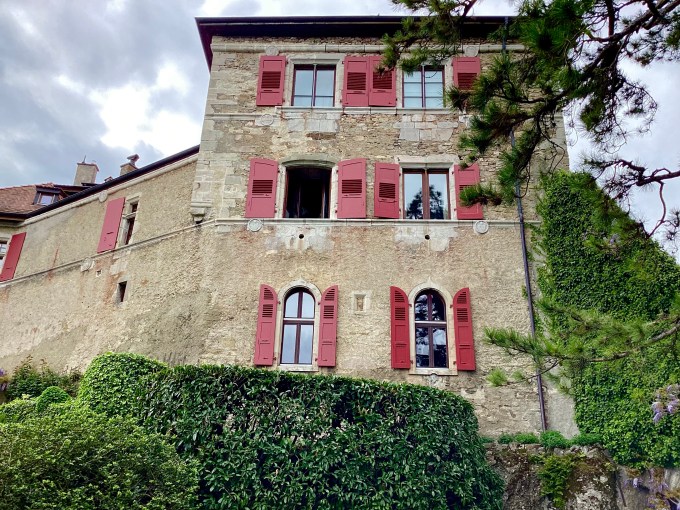
You can live here. These apartments are for rent.

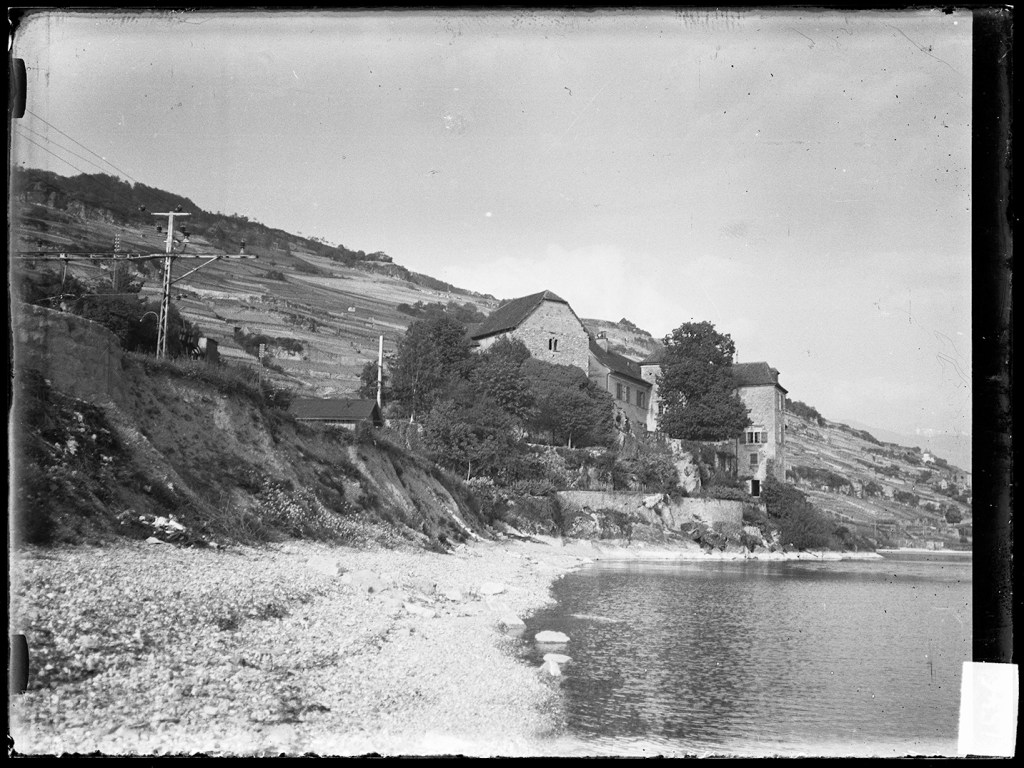
Same vantage point 125 years apart: Château de Glérolles in 2025 and 1900.
Lavaux Terroir
The dizzying slopes of Lavaux harbor a myriad of terroirs, all with a common theme: sandstone (molasse or grès, in French). In St-Saphorin the sandstone is inter-mixed with puddingstone (poudingue, in French), a conglomerate rock formed from small rounded stones cemented together with silica. This mother rock is so tough it survived the advance and retreat of the Rhône glacier, which scooped out the lake’s basin 20,000 years ago. The puddingstone is so pronounced in parts of St-Saphorin and Dézaley that it is visible at the surface, which makes for a very shallow substrate.
An exceptional feature of the home vineyard is the presence of pure white limestone at a depth of one meter. According to Grégoire it is the limestone that gives the Réserve Blanche its rich creaminess and distinct minerality. Its quite different from the usual salty umami character I find in many wines from St-Saphorin.
The Wines
Réserve Blanche: Opulent is not a word I often use to describe chasselas, even when describing the acknowledged greats, but it’s a word that always comes to mind when I taste a new vintage of Réserve Blanche. Creamy and exotic are two others. When I ponder the reason why there is so much creaminess, I have to conclude that it’s the terroir. And by terroir I mean not only the limestone in the vineyard but also the proximity to the lake and the blinding light and steamy heat emanating from it. Believe me, they can be intense and their affects are often underestimated.
In less than ideal vintages the grapes are treated to a strict triage. Fermentations are invariably cool, between 16º-18ºC, and take place in enamel-lined cuves. A full malolactic fermentation is routine but can be varied according to vintage conditions. Aging takes place in enamel-lined stainless steel cuves before bottling.
I’ve come to expect mostly floral elements on the nose as well as yellow plum and pear. Along with the usual textural richness there is a pear-like mealiness with green apple and citrus flavors. It finishes with a pleasing bitterness that is typical of fine chasselas.
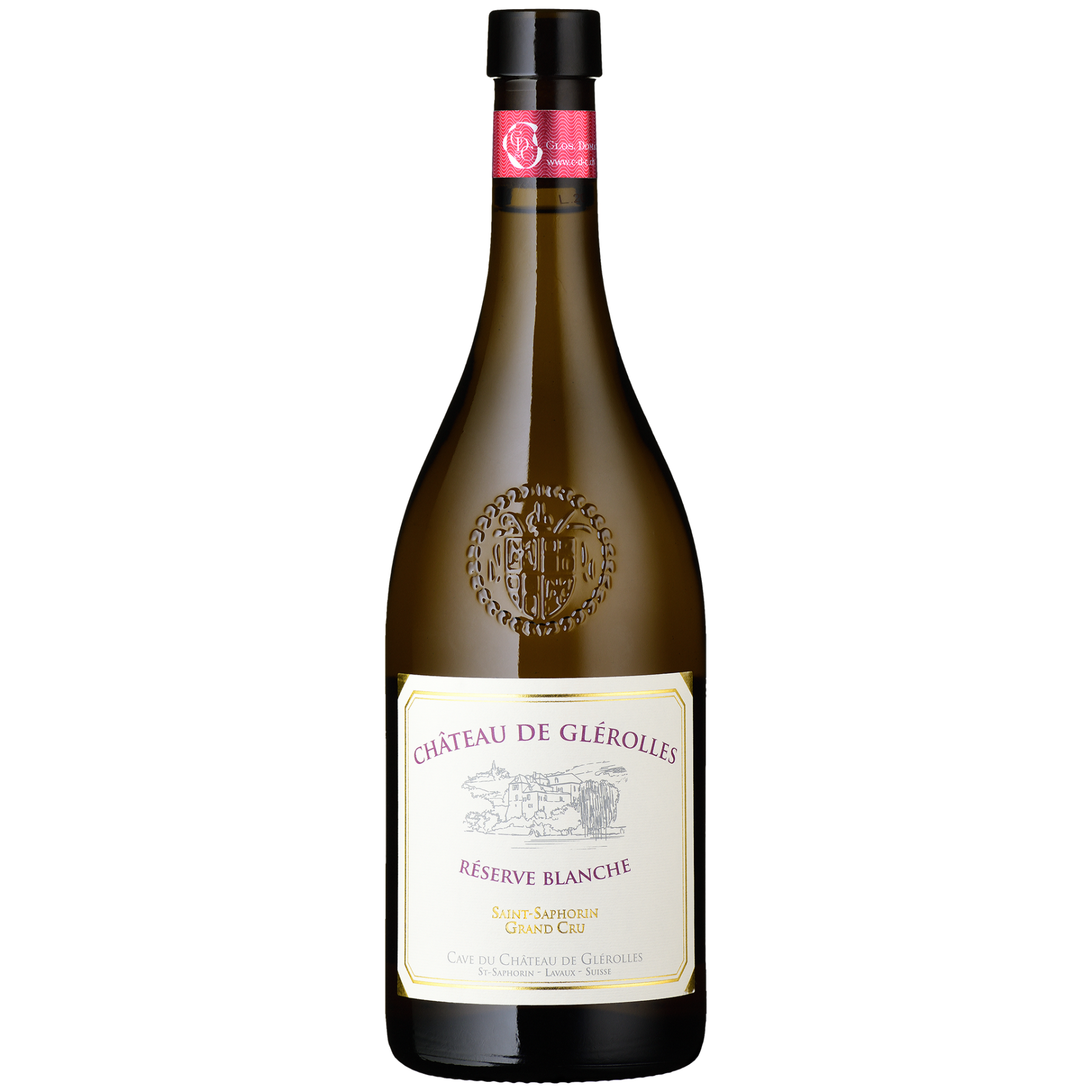

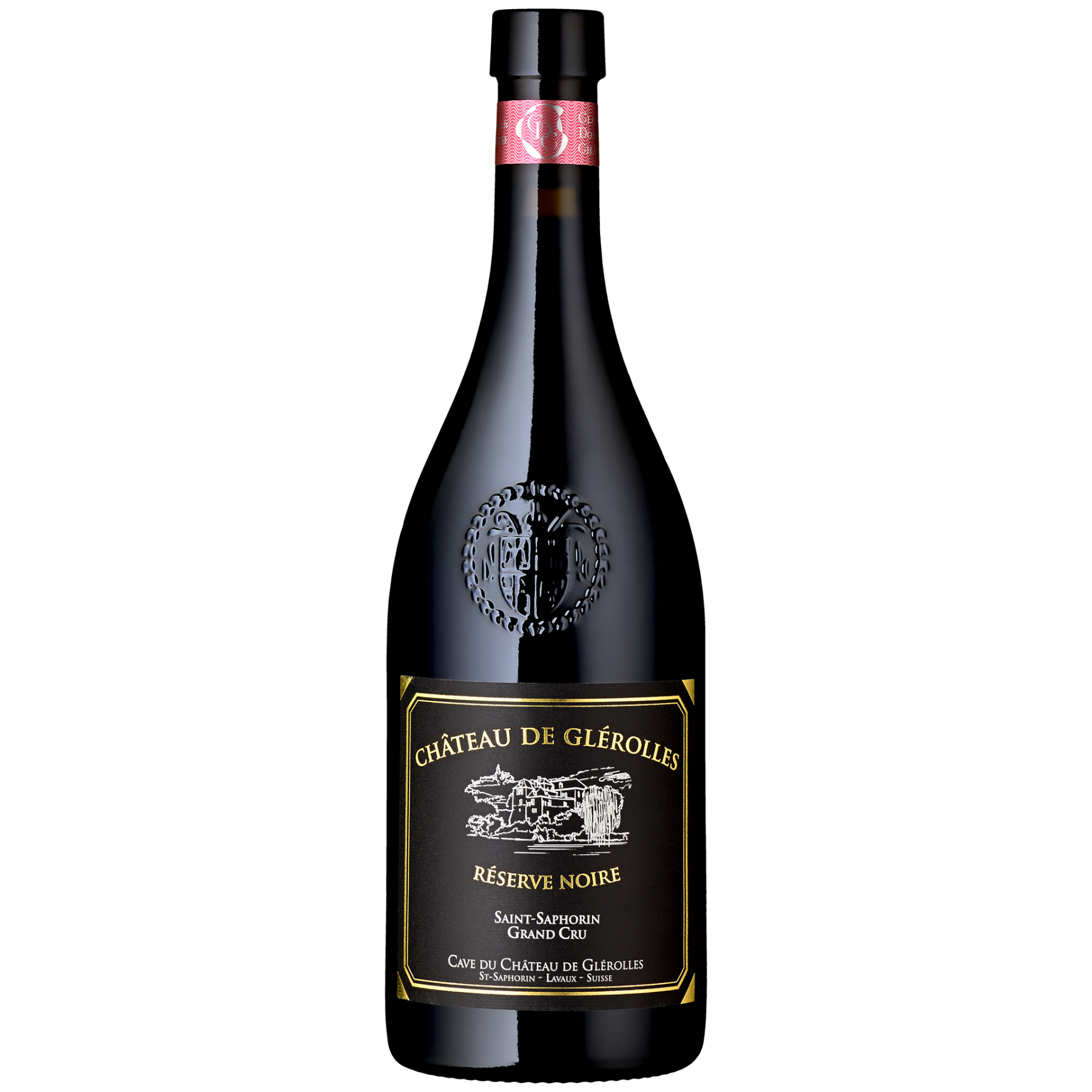
Humagne Rouge: As Glérolles is the only authorized home for humagne rouge outside Valais, it’s fun to compare their version to those from the Motherland. First, the term rustic, which is often used to describe the variety, does not quite fit here. The Glérolles version is raised in 225 liter French oak barriques which is an extravagance that not many can indulge in. In my opinion, the oak serves to smooth out the variety, which in other iterations can be angular and somewhat austere.
My experiences with humagne rouge always transport me to a place between Burgundy and the Rhône—or more exactly between pinot noir and grenache. At its best, humagne rouge has the finesse potential of pinot and the warm exuberance of grenache. I believe the rustic tag comes mostly from the winemaking and not from the grape itself.
At Glérolles the humagne rouge seems to take on a darker hue and is not as transparent as those from Valais. Indeed, it is more opaque. The fruit, too, is darker and more reminiscent of blackberries and blueberries with more palate saturation than examples from Valais, which tend to emphasize red fruits like strawberry and raspberry.
Instead of rustic, I would label the Grérolles sophisticated and polished. There is no doubt the oak has a hand in this. There is also the gorgeous scent of new suede which also suggests a smooth textural element with just a bit of grip.
This wine deserves to be better known, but, alas, there is very little of it to be had.
Réserve Noire: Like the humagne rouge, the Réserve Noire gets the full barrique treatment. It’s a bit unusual for a blended wine from Vaud in that it does not contain any gamaret or garanoir, two siblings intentionally bred in the canton to add weight and color to blends. Nevertheless, the Réserve Noire is full-bodied, full of dark fruit, and finely textured.
Wet stones and graphite are featured on the nose, as well as new leather, sage, and other fresh herbs. It is a very successful blend that performs quite well in tastings among it peers.
Discover more from artisanswiss
Subscribe to get the latest posts sent to your email.
 artisanswiss
Thank you, Dennis Lapuyade, for another informative and educational article on Swiss wines. I remember driving past St. Saphorin on the way to Vevey to visit Charlie Chaplin’s statue near the Alimentarium and that famous Fourchette on the lake.
LikeLike