To invoke a well known mnemonic from the world of spirits—All tequila is mezcal, but not all mezcal is tequila—I propose a Swiss wine counterpart: All Dézaley-Marsens is Dézaley, but not all Dézaley is Dézaley-Marsens.
Let me explain.
The Dézaley Grand Cru AOC is well known to Swiss wine lovers as the crown jewel of Lavaux and the source for what many believe is the highest expression of chasselas in the world. Not so well known is that within Dézaley’s 54 terraced hectares lies an enclave of 8 hectares worthy of special recognition. Article 4.2 of the Règlement des Vins Vaudois allows for grapes grown within these 8 hectares to use the name Dézaley-Marsens Grand Cru AOC, as long as they are grown and vinified according to the same cahier des charges as Dézaley. If all of the enumerated requirements are met, then a vigneron is free to use either name.
Thus all Dézaley-Marsens is Dézaley, but not all Dézaley is Dézaley-Marsens.
A Vineyard Within a Vineyard
Looming above the Marsens vineyard is the Tour de Marsens, one of Lavaux’s most famous landmarks. It was built sometime in the 12th century with ownership passing between the Church and private hands in the centuries since. Its distinctive crenellations identify it as a former defensive outpost chosen for its sweeping view of the French Alps, the Rhône delta near Villeneuve, the Bernese Oberland, and the gap at Fort l’Ecluse near Geneva—through which the Rhône flows into France. It is one of the most awe-inspiring views in Switzerland and, perhaps, the most iconic of all Swiss vineyards.
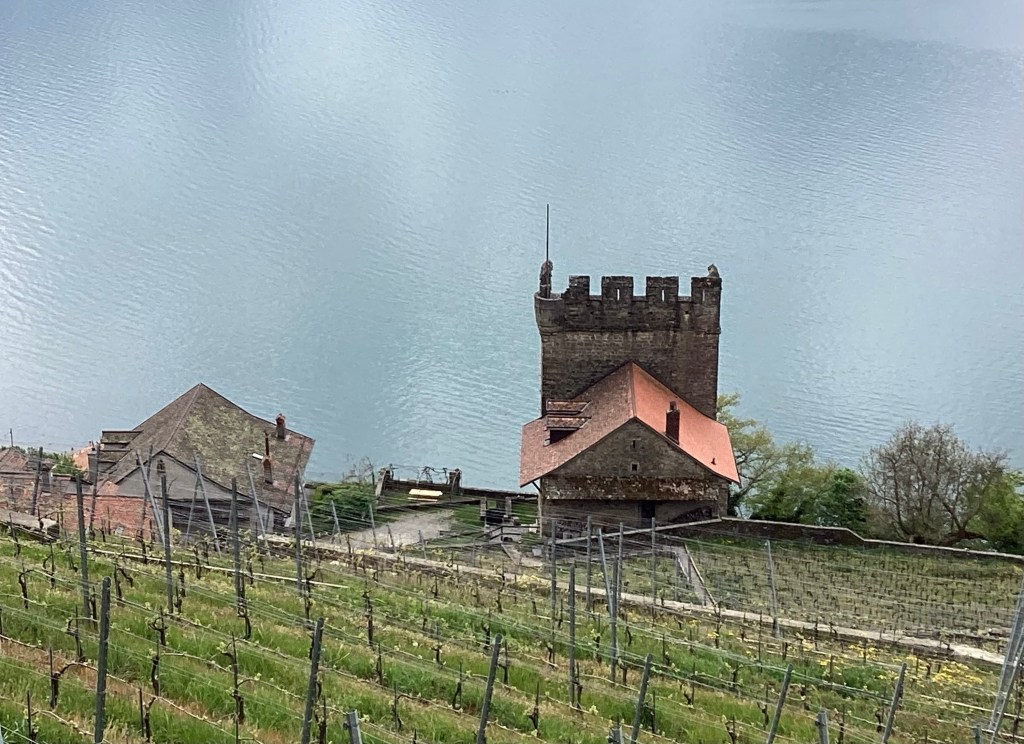
View from above the Tour de Marsens. It’s more than 200 meters straight downhill to the lake.
The enclave itself is wedge-shaped with a northern border contiguous with Dézaley’s. Its southern border runs along the touristy Route de la Corniche, and includes all of the area between the Chemin de la Chapotannaz to the east and the Chenalettaz stream to the west. (Click the link for an interactive map: https://s.geo.admin.ch/bj40ornenl5u)
This part of Dézaley is steep (which part isn’t?) and subject to thermal currents which move warm air upslope from the lake. This circulation of air is vital to ward off disease and frost and to regulate temperature. Nevertheless, at 150-200 meters above the surface of the lake, the Marsens vineyards are typically 2-3 degrees cooler than those below.
As expected, chasselas dominates the Dézaley vineyards with 85% coverage, but in Dézaley-Marsens the number is even greater. Red varieties tend to do better lower, closer to the lake, or when situated adjacent to heat-retaining stone walls.
The Marsens vineyards are shared among several growers, but not everyone entitled to use the name chooses to do so. Indeed, harvest records indicate more Dézaley-Marsens grapes are harvested each year than are labeled as such. Why? For some, to avoid the hassle of multiple labels; for others, because Dézaley needs no embellishment.
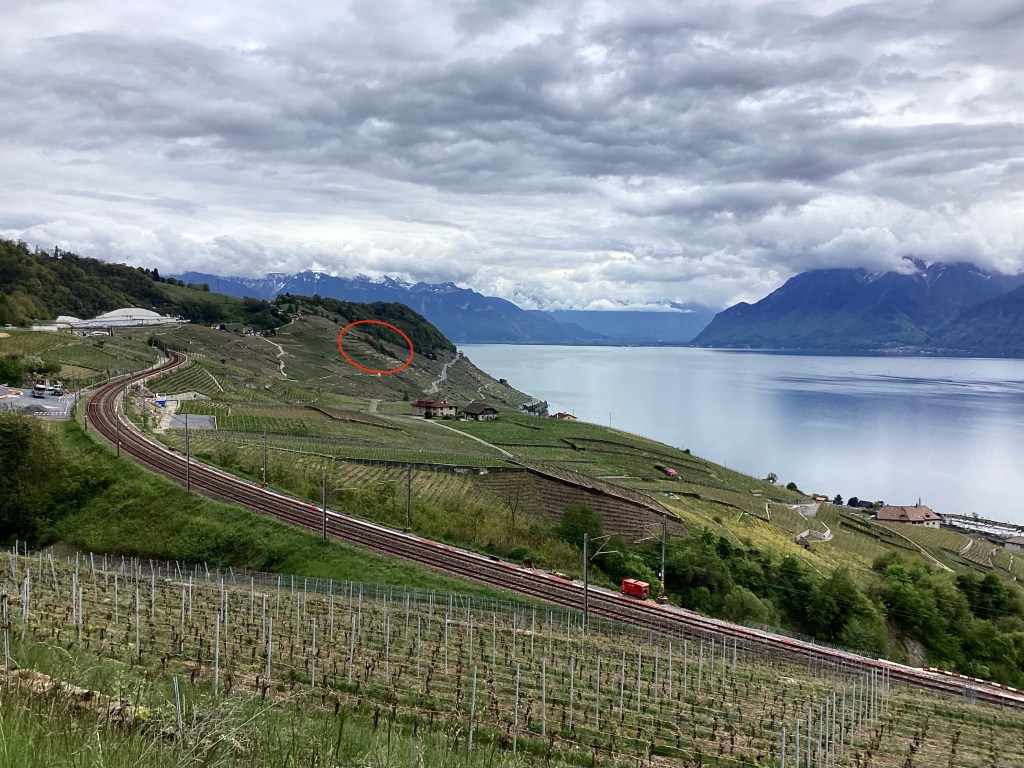
View from above Epesses looking east towards Dézaley. The Tour de Marsens is circled in the photograph. The Rhône as it enters the lake is in the distance.
Pioneers of an Appellation
The name most often associated with Dézaley-Marsens is that of the Dubois family, originally from the village of Mézières, north of Lausanne. Their story begins in 1927 when Oscar Dubois, winemaker at the famed Dézaley vineyard, Clos des Moines, and great-grandfather to the current operators, Grégoire and Frédéric, purchased a home and vineyard adjacent to the tower. Upon his untimely death, in 1936, his wife assumed control and operated the property until her sons, Marcel and Gaston, were able to take over in 1947.
The transition to the young brothers marked the beginning of a sustained period of growth and prosperity for the family. From a few hundred square meters of the original stake, the brothers gradually expanded and found themselves in need of more space. In 1957, they purchased a second facility in Epesses to supplement the increasingly cramped and isolated tower property.
The 1970s brought about seismic change.
As the two families grew the brothers decided to split their business interests. Marcel’s family settled in the village of Cully at Le Petit Versailles, purchased in 1973, while Gaston’s family settled in Epesses at Le Vieux Pressoir. Today, the two entities, Les Frères Dubois and Dubois Fils, carry on as separately owned operations, though both are known for exceptional Dézaley-Marsens.
The 1980s ushered in the modern age and with it another change in leadership. Marcel’s son, Christian, took over amidst a changing Swiss wine industry. His contributions are legendary and, though grounded in tradition, are also seen as visionary.
He guided the family winery through the adoption of the Vaud AOC in 1995 and was a founding member of La Baronnie du Dézaley in 1994. The latter was established to safeguard and elevate the stature of Dézaley by adopting a quality charter that built upon and, perhaps, influenced the AOC regulations to come.
His approach to aging chasselas in oak tuns, for instance, was a bow to tradition just as the popularity of stainless steel was sweeping the region. Oak tuns impart no flavor to wine but provide the crucial elements of texture and breadth in a way that stainless steel does not.
He also resisted the modern impulse for transparent, fruity wines by insisting that his best cuvées complete their malolactic fermentation. Only then, he averred, is the expression of terroir possible. Top winemakers in Vaud seem to agree, as this critical choice distinguishes Vaudois chasselas from chasselas made elsewhere in Switzerland.
His vision for the ultimate terroir-driven, age-worthy chasselas was born in the year 2000 with the introduction of Vase No. 4, a cuvée sourced from the best and oldest parcels adjacent to the tower. The plot itself measures 2.5 hectares and is almost always harvested in the month of October. In fact, only a handful of times since 2000 has the harvest occurred before October 1, which is quite a record as chasselas is one of the earliest of the early ripening varieties.
Today the company is run by another set of brothers, Grégoire and Frédéric, with their wives and children. Yes, the next generation is already in place. Frédéric is the winemaker and Grégoire handles sales and promotions—but don’t sleep on Grégoire’s palate, he won a prestigious chasselas tasting competition, the 75th Concours Jean-Louis, against stiff competition and with his victory he earned the famed Chapeau Noir.
On my visit, Grégoire proved to be the consummate host. He generously escorted me around the vineyards and through the cellar to taste some soon-to-be-bottled wines. We finished up in the upstairs retail space/wine bar for more tasting from the bottle.
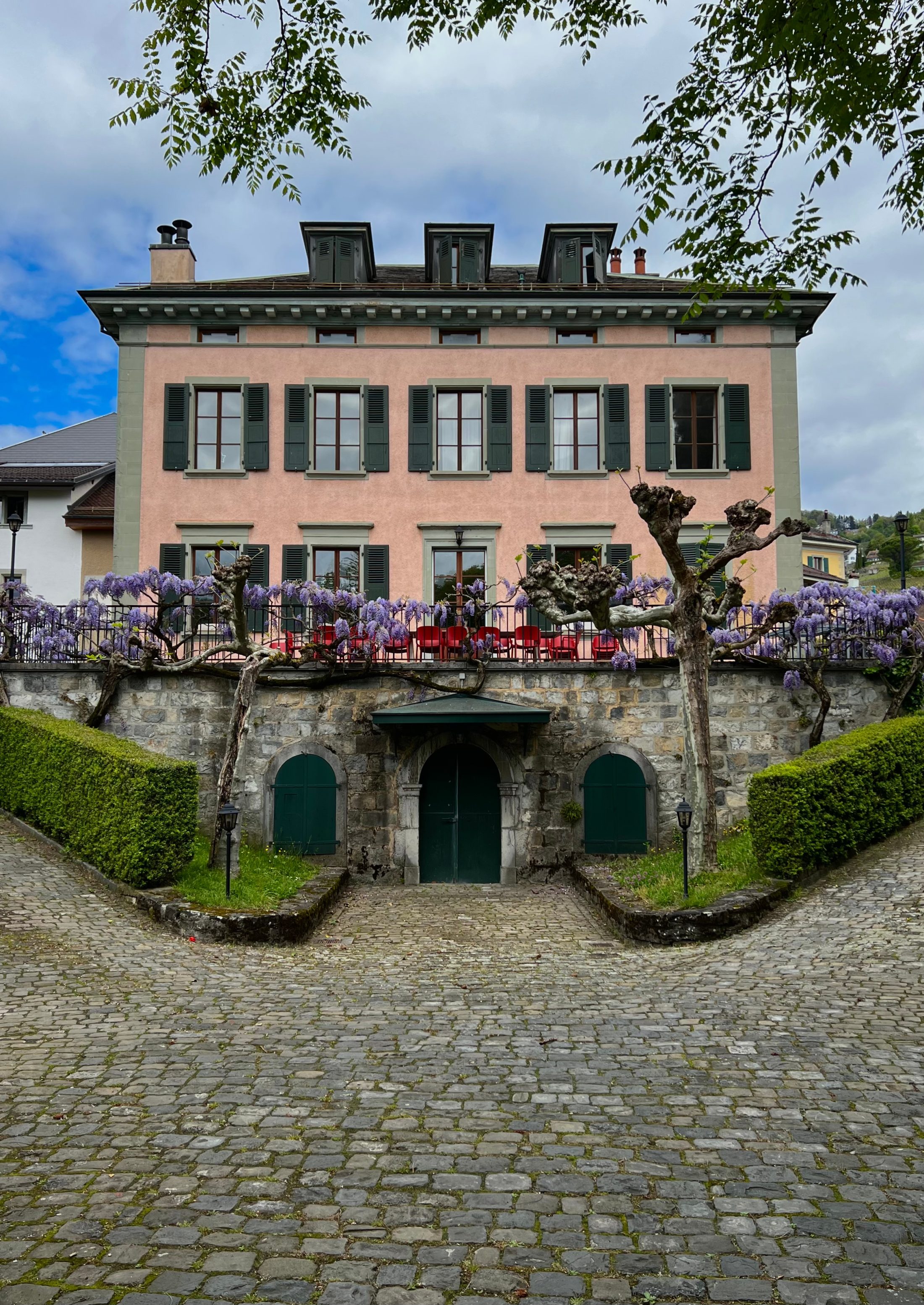
Le Petit Versailles
A Growing Enterprise
Le Petit Versailles is the nerve center of the Frères Dubois enterprise. It is a nineteenth century, purpose-built winery done in a French architectural style. In addition to the company offices and retail store, the villa also serves as the white winemaking hub for the entire operation. The reds are made in St-Saphorin and Puidoux.
There are three Dézaley-Marsens cuvées: The Dézaley-Marsens de la Tour Vase No. 4; a non-reserve Dézaley-Marsens de la Tour; and a rare pinot noir known as Réserve des Héraults.
By the way, Vase No. 4 is not a nom de fantasie but signifies the fourth in a series of numbered tuns, or vases in French. The original Vase No. 4 was a creaky septuagenarian that held 3700 liters or roughly 5200 bottles. It was replaced in 2008 by an even larger one with a capacity of 6300 liters (equivalent to twenty-seven 228 liter barriques) or 9000 bottles. A photograph on the cellar wall depicts the logistical challenge encountered by the Swiss National Railway as it attempted to deliver the original tun to Lavaux by freight car.
The brothers also maintain a presence in Epesses at Domaine de Baussan, known for its excellent reds, merlot in particular, and in St-Saphorin at the Château de Glérolles.
There are numerous other labels, including a well-priced, cellar-worthy chasselas, La Braise d’Enfer, named for a stream that runs through the village of Epesses. Another is the Le Petit Versailles range which showcases grapes from farther afield, including village reds and whites from Villette, Chardonne, Epesses, and even one from La Côte—the Clos des Abbesses, near Morges. There are also cuvées from the two Grand Crus, Calamin and Dézaley.
Two communal wines from St-Saphorin and Puidoux round out the assortment. Both are classy and worth seeking out. The latter is made from chasselas planted just above the Tour des Marsens.
In addition to the 20 hectares they farm in the communes named above, the brothers also make wine for a roster of clients.
People love to talk about how well chasselas can age, but only a few have the resources to prove it. Among the myriad cuvées on offer, the family also maintains a library of older vintages available to the public at very reasonable prices. A serious chasselas lover can purchase 9 vintages of Vase No. 4, 20 vintages of the non-reserve Dézaley-Marsens de la Tour, and most vintages of La Braise d’Enfer and La Réserve des Héraults back to 1973. New to the list is La Réserve Blanche (Ch. de Glérolles) going back to 2006.
Truly something for everyone.
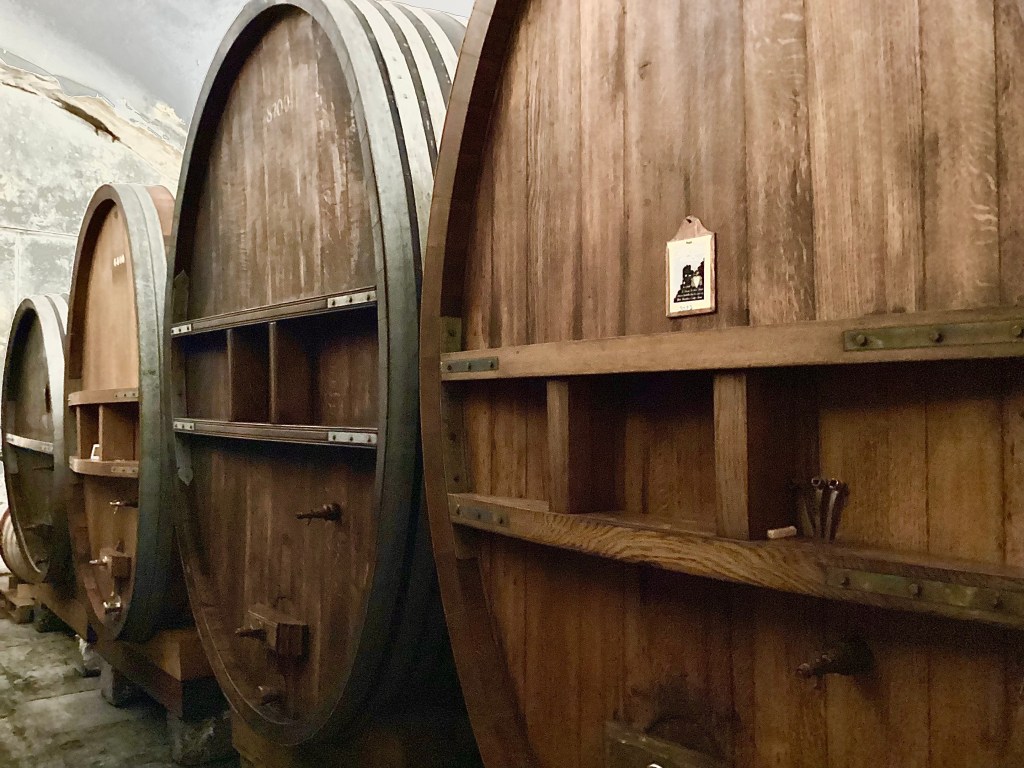
The new Vase No. 4 and several of its numbered friends. Les Frères Dubois are proponents of chasselas aged in oak.
The Wines
Once in the cellar, Grégoire led me to a huge oak tun, named Vase No. 2 if I remember correctly, which contained the 2024 La Braise d’Enfer. This is another chasselas cuvée that benefits from the oak regimen championed by the family. The 2024 was bright with a lemony tang and a bit of the melting texture time in wood provides.
Deeper within the cellar was a battery of enamel-lined steel tanks that serve as a halfway house for cuvées destined for additional oak aging. It was there we found the 2024 Dézaley-Marsens cuvée awaiting transfer to Vase No. 4. The tank sample was gorgeous with the kind of pineapple and caramel notes that most wineries would be in a hurry to bottle. And they wouldn’t be wrong to do so—it tasted that good. But the Frères Dubois want more from their top cuvée—namely, the expression of terroir.
As a counterpoint, the 2023 Vase No. 4 was drawn directly from the tun, and it could not have been more different. Compared to the 2024 tank sample it was backwards and disjointed but clearly a giant in the making. It’s always evident to me that chasselas from a hot year and a great terroir has a better than average chance for greatness. I’m sure the 2023 Vase No. 4 will be no exception. The 2023 was just a week or so away from bottling, after which it will gather itself and develop for 10 years or more.
From the cellar we made our way around the villa to the retail space/wine bar where visitors gather to sample and purchase from a rather large roster of wines.
First up was the 2023 St-Saphorin, a chasselas from the commune of the same name. As already mentioned, 2023 was a hot year so 20% of this cuvée had the malolactic blocked to preserve some freshness. Nevertheless, the wine had all of the umami character I associate with chasselas from St-Saphorin. It was saline, savory and textured.
The 2023 Puidoux “Résidence Episcopale” is from the same hot vintage but it managed to preserve the minerality I find typical of chasselas from Dézaley. Remember, the vines for this cuvée are located above the Tour de Marsens, an area unofficially known to insiders as Dézaley Supérieure.
The 2022 Côtes de Baussan Merlot from Epesses was notable for its rusted iron, almost bloody flavor. This will never be mistaken for Pomerol, or Ticino for that matter, but it is charming in its own way with soft tannins and plenty of plump fruit.
Next up was the 2021 Le Petit Versailles “Dézaley” a 100% gamay cuvée that spent 15 months in barrique. It was verging on over ripeness, but was delicious nonetheless with a violet, red berry, and a subtle milk chocolate character.
Last up was the 2004 Dézaley-Marsens de la Tour Vase No. 4 (Vase No. 4 bottles used to be indistinguishable from the non-reserve bottles because both had white capsules and very similar labels. These days Vase No. 4 carries a gold capsule as well as more prominent markings on the label.) This was not the greatest Vase No. 4 I’ve tasted—the 2000, 2003 and 2005 are otherworldly—but it fully represents what the brothers hope to achieve. It opens with a healthy gold color and a slight petrol aroma reminiscent of aged riesling. There are also notes of fresh mushroom, caramel, and barley sugar—the last has me thinking of mature Sauternes.
It was a pleasure to drink and a fitting end to a very special day. Many thanks, Grégoire.
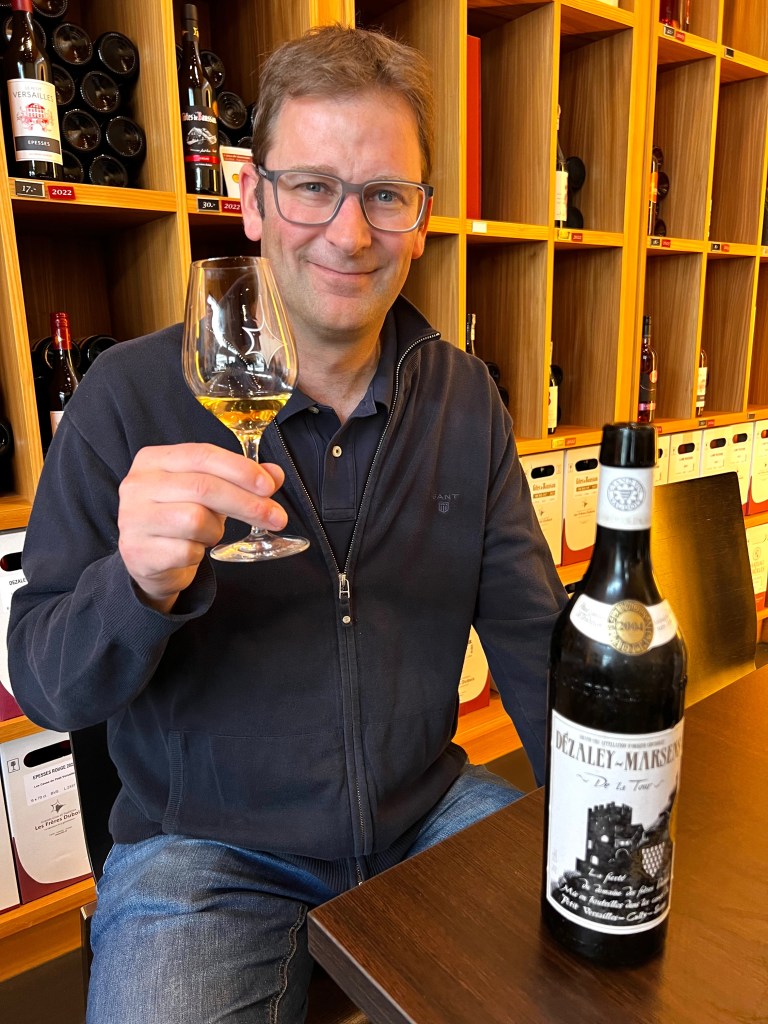
Grégoire Dubois: My genial host
Discover more from artisanswiss
Subscribe to get the latest posts sent to your email.
 artisanswiss